Ashley Miller – October 2023
Four days after Hurricane Sandy swept through Red Hook, Brooklyn, Domingo Navarro waded into Dwight Street wearing his neighbor’s rain boots to assess the damage done to his 1993 Honda Civic. The 54-year-old union leader was distraught to find his vehicle, which he relied on for transportation to work in New Jersey, submerged in three feet of sludge.
Pushing against pressure from the flooded street side, Navarro managed to pry open the driver’s side door. The orange interior was damp and reeked of raw sewage. Navarro tried to start the ignition and was nearly electrocuted. “I could’ve been fried!” he said.
A decade later, Navarro faces a new car-related conundrum: The horde of contractors tasked with the ongoing Sandy reconstruction efforts in Red Hook routinely park in spots for public housing residents.
“It’s not just our spots,” said Navarro. “We get no respect, and we’re the ones who live here. This is our neighborhood!”
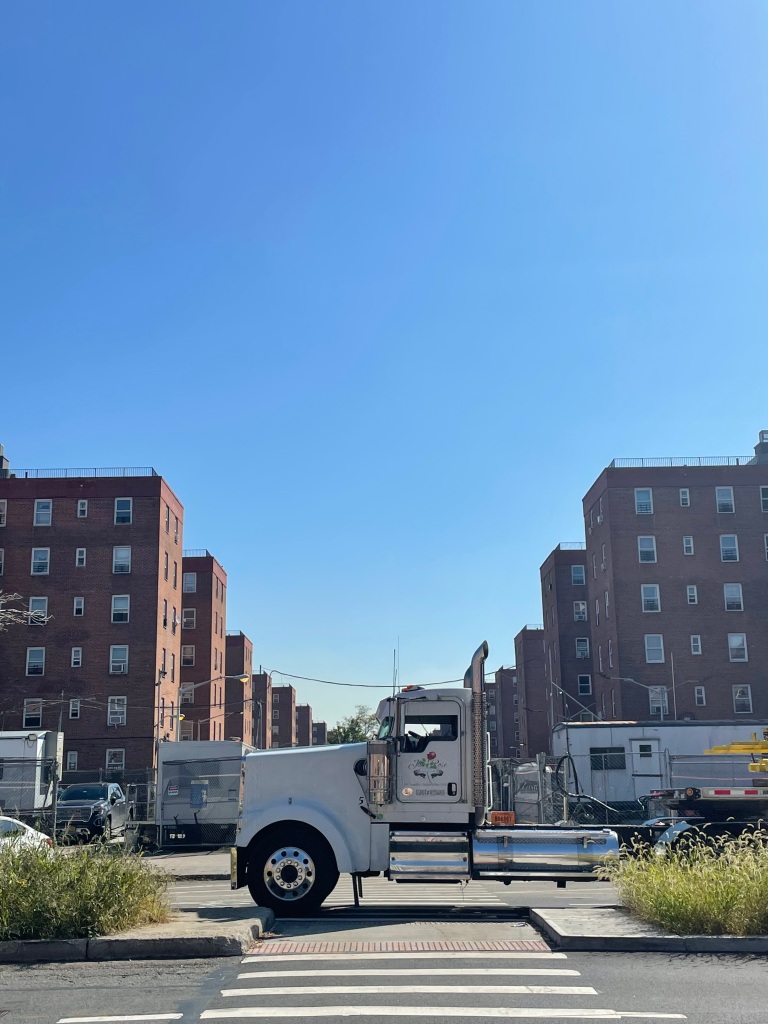
Blocks from an Amazon warehouse on the Brooklyn waterfront, the New York City Housing Authority’s Red Hook Houses comprise 28 six-story brick buildings within a 60-acre perimeter. After Sandy pummeled the public housing development, FEMA proposed a $550 million reconstruction plan. The (historically slow) federal response agency estimated construction would end in 2017. Five years later? The work shows no signs of slowing.
Scaffolding shades the concrete landscape. Walking through a maze of metal, it’s difficult to tell one building from the next. All green space has been excavated into mountains of mud. Idle playground equipment litters the landscape.
When Hurricane Sandy touched down in 2012, water levels reached eight feet in sections of Brooklyn, destroying homes and businesses. Residents of the Red Hook Houses, the second-largest public housing development in New York City, were left without heat, power, and water for weeks.
“It was like New Orleans after Katrina,” said Frances Brown, 72, president of the Red Hook East Residents Association as she recalled the residual wreckage.
Red Hook is an isolated enclave on Brooklyn’s western shoreline. The neighborhood sits beside one of the most polluted waterways in the country: the Gowanus Canal. During Sandy, the surge of dirty runoff water combined with the district’s overflowing sewage system. (Yuck.)
Brown said tenants on the first floor had sewage dripping from their sinks and bathtubs. “We still have mold and mildew around from the dampness and disease of all that flood water,” she said.
Sandy’s wrath impacted 35 NYCHA developments, serving over 60,000 residents. According to City Comptroller Brad Lander, all developments are still struggling with storm damage. “The lack of progress acutely affects public house residents,” he said.
On the other end of the neighborhood, the high-income area has recovered from the storm. But public housing residents still live in an active construction zone while NYCHA contractors inch away at recovery efforts.
Contractors have raised the electrical systems up several floors, brought in backup generators, and resurfaced “some of the roofs in the development,” according to Hana Kassem, the head architect behind the blueprints. (But she could not provide the exact numbers). She said they’re raising all the lawns between the structures to create water storage centers. “But the process is time intensive,” Kaseem said. And the timeline is out of her hands.
Some Red Hook residents say if the problem afflicted a more affluent area, the project would be complete and contractors would cause less of a disruption.
“If this was a different neighborhood,” said Navarro. “If we had more money and more of us voted, the city would’ve taken care of this by now.”
With a little over 11,000 residents in Red Hook, over half the population lives in the Red Hook Houses, according to data from the Red Hook Community Health Center. 47% of the public housing residents are Hispanic and 45% are black. Only 2% are white.
“The area is just crumbling as opposed to being built up,” said Chris Perez, a 45-year-old longtime resident. “We had big park patches, but they dug up everything. When I look outside, it’s just fences, dirt, dust, and bulldozers.”
Perez said NYCHA crews have removed hundreds of trees during construction. But they will not replace them because FEMA won’t cover the cost. “Trees, shrubs, and other planting are not eligible for replacement,” Sara Wengfield, a California-based FEMA representative told me.
Will Holland, an urban landscape adjunct professor at the University of Virgina, is concerned the NYCHA contractors ripped out too much of the natural landscape. “Trees have a root system that helps to stabilize the soil, and with no more roots, it’s bad, it leaves the area susceptible to runoff,” he said.
But Brown, the Residents’ Association President, contends that most of the trees were dead before construction began. “I was glad they cut them down because some of them were rotten before the storm, and they were leaning so far I thought someone was gonna get hurt!”
Brown said residents complain about not feeling included in the construction-timeline conversation. She tells them, NYCHA held multiple meetings with the community to discuss the project.
“NYCHA showed the plans of what they were going to do, you know, and I don’t understand why people didn’t bring their concerns to earlier meetings,” she said.
Navarro said some residents could not attend the meeting. “Some of us work,” he said. “Some of us are tired after we work all day. We can’t make every meeting. And then they hold that against you, telling us we can’t complain. It’s unfair.”

Amid the back-and-forth, aging residents like George Broughton, 72, who’s lived in the development since 1965, feel that “it’s a fight for the next generation because I won’t be around. I’ll die in this dust.”
NYCHA’s communications manager, Michael Horgan, said over email that construction will be complete this fall. But contractors on the scene scoffed at this suggestion and said the project is far from finished.
“Look, it’ll probably be another year,” said Randall, a construction crew member. He said he’s tired of fielding complaints from residents about the prolonged timeline. “They [residents] just don’t understand,” he said, adding any big project is bound to have delays.
“There’s always gonna be one side saying this and another telling us that, but where is the truth?” said Broughton. “We live here. Don’t we deserve to know the truth?”
Another Red Hook resident, Pedro Sanchez, 39, said NYCHA tried tackling too many projects at once. “They dug up all the lawns on the East and West side,” he said. “They should’ve done one before doing both at once. It seems like common sense.”
One disgruntled NYCHA contractor enjoying a smoke break under scaffolding beside Red Hook East said, “It’ll be done when it’s done.”
 ashley elizabeth miller
Please leave your thoughts!