Joan Didion was ahead of her time in surmising the fate of US politics: Americans love celebrities and the dirt about candidates, but don’t much care where their preferred player stands on policy. Is the press not a tool to help people understand how these elections shape their lives? When did it become about who had friends in higher places, who had a better baseball throw, or a nicer tie around their neck?
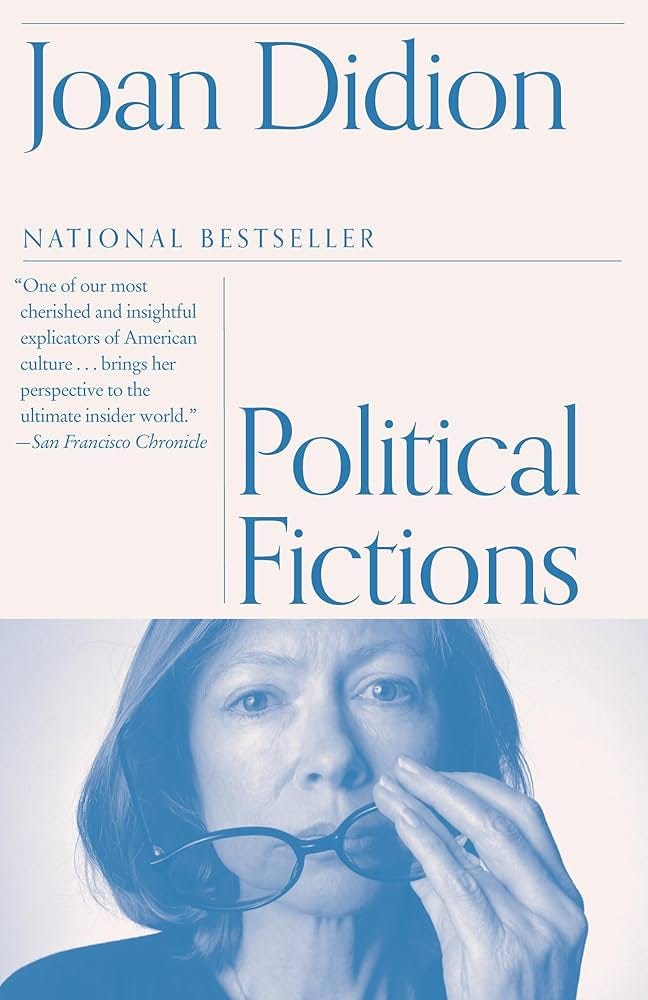
Didion saw no need to add to the country’s anxiety, driven by surface level reporting and horserace metrics. She critiqued what she saw as the new normal political coverage in her 1988 essay “Insider Baseball” on the contest between George H. Bush and Michael Dukakis.
Originally written for The New York Review of Books, her essay shows how news outlets, driven by the need to compete with broadcast commentary, began using their pages as political PR — reporting on appearances and false promises over policy issues — coming to the conclusion that: American politics is all about performance. And in the final days of the race — politicians’ true colors come out, as they solely parade around states that could push them across the finish line in November.
No different than today — Harris and Trump are down to the wire, with less than a week until Election Day and have been hitting the five swing states hard: Pennsylvania, Michigan, Arizona, North Carolina, and Georgia.
Reporters use all sorts of sports lingo to paint the candidates and their campaigns: as winners and losers, one “destroying” the other on Election Day. And they obsess over pre-election polls.
If only Didion could see polling coverage today.
Didion On Jon Stewart
“Don’t speak for the dead,” so the old saying goes…
Here I go anyway: Didion would have liked Jon Stewart.
Not a player in mainstream media, Stewart uses satire to tear down the wall of US politics by talking to experts, agency heads, candidates, world leaders — to discuss, listen, learn, expand, or debunk his views— all done in an off-the-cuff interview where the interviewee is made to feel extra warm and fuzzy by the show’s animated audience.
Stewart Interviews Josh Shapiro
When Harris chose Tim Walz, the Minnesota governor who canonized the word weird, some folks questioned her decision, favoring Pennsylvania Gov. Josh Shapiro instead.
Stewart sat down with Shapiro for a revealing interview on The Daily Show Monday — one which Didion would’ve enjoyed for how Stewart unveiled the cloak covering Shapiro — a popular new name in US politics — revealing him to be not so great.
My no. 1 takeaway? J.D. Vance would have destroyed Shapiro in a debate.
How To Interview Like Stewart
Always assume a politician is lying to you — Astead Herndon
It didn’t take much to get Shapiro to stumble. In fact, he nearly left mid interview after walking into a sex joke. Story goes, Shapiro was asked to be vetted for Vice President. So he had to get his taxes in order, and one night while organizing such files on his bedroom floor, on his hands and knees, his wife walked in:
“Oh honey, if only the American people could see you know,” she said.
In between snorts, Stewart jumped in, “Bet the American people are imagining you in that position right now!”
Poor Shapiro.
Now Stewart has made Shapiro more human, making him feel real to viewers at home. Then he digs into controversy: Shapiro’s stance on Gaza, revealing how pro-Israel the Pennsylvania governor truly is. With sympathy, Stewart says he has Jewish family members and friends who share Shapiro’s views.
“But you all have very different politics than my own,” Stewart said.
Short Aside For Journalists: How To Interview Like Stewart
- Disarm your interviewee — bring them down a notch, make them feel real to your audience, connect with them on a human level — maybe try a joke.
- Ask the tough question — once disarmed, ask your interviewee the tough question — the number one thing you want to know.
Lastly: Candidates And Character
Stewart and Didion know the race is won by a candidate’s character — and who reflects the current tilt of American social values.
Didion first made me obsessed with the word character not from her political reporting but from her first essay in Vogue: “On Self-Respect.”
Character is the willingness to take responsibility for one’s own life, and character is the source from which self-respect springs.
By the definition, Trump’s has neither character nor self-respect.
 ashley elizabeth miller
Please leave your thoughts!