
In the fog of paranoia animating Cold War America, the newly elected President John F. Kennedy enacted a failed plan to overthrow Fidel Castro’s communist regime in Cuba: known as the Bay of Pigs. The U.S. knew the Soviets were funding Castro’s takeover in Cuba, which is why they planned to attack on the ground and get control of the country.
The Soviet Union saw this American offensive on communism as a threat and as a sign of weakness. So, in the same year, Prime Minister of the U.S.S.R Nikita Khrushchev ordered the erection of the Berlin War. This physical divide separating east and west Berlin became an iconic symbol of division between the Soviet and Western blocs of the world.
How did Kennedy respond to news of the wall?
“It’s a hell of a lot better than war,” he said.
Tear Down That Wall!
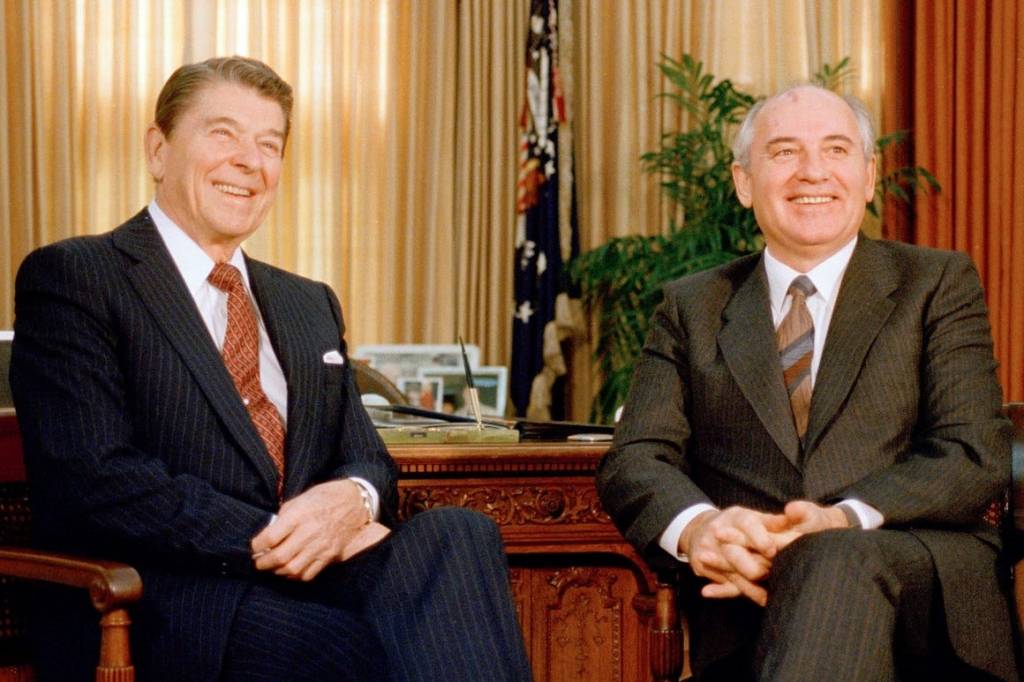
In 1987, President Ronald Reagan famously asked the Soviet leader who came to power two years earlier, Mikhail Gorbachev, to tear down the Berlin Wall. And in 1989, Mr. Gorbachev did just that. He was then awarded the Nobel Peace Prize in 1990.
After Gorbachev was given the award, his openness began to be seen by some Soviet officials as weakness to the union’s survival.
New Head Honcho In Town
Then came Boris Yeltsin, a brash politician who championed Russian nationalism over Soviet unity. Running on a platform that prioritized Russian independence, he joined forces with other Soviet republics, including Ukraine, to declare independence from Gorbachev’s Union.
When Yeltsin charmed his was to presidency of the newly independent Russian Federation in 1991, the Soviet Union became little more than a meatless skeleton.
Russian Federation: From Communism To Capitalism
Under Yeltsin, Russia made a dramatic move: transitioning from communism to capitalism. This shift was immensely mismanaged, as a handful of well-connected businessman bought all the major companies — oil, gas, electric — thereby controlling the state and giving rise to the infamous oligarch class. The botched reforms killed the public’s trust in capitalism and further fractured the country’s stability.
Yeltsin himself was a deeply flawed leader. Known for his alcoholism and erratic, often angry, behavior, he became an international embarrassment — most infamously when, during a U.S. visit, he was found in his underwear on the streets of Washington, D.C., asking for a taxi and pizza. And back in Russia, his close ties to the oligarchs, who effectively bankrolled his re-election campaign, only deepened his unpopularity.

Yeltsin Searches For His Successor
As his health and reputation deteriorated, Yeltsin began searching for a successor. Three candidates were tested, but none worked out. Then, in a surprise move, Yeltsin bypassed his shortlist and turned to a virtually unknown former KGB officer named Vladimir Putin. Yeltsin backed Putin, believing the bureaucrat would safeguard his legacy — and perhaps protect him from future legal scrutiny. (Ring any bells, America?)
Destiny, Chance, Or Accident? All Hail Putin
And so, due to the will of a corrupt, mean, alcoholic who changed the country’s fate forever, Vladimir Putin rose to power. What began as a last-minute decision by a weakened leader has since defined the course of Russian history.
“Believe only half of what you see and nothing that you hear.”
— Edgar Allan Poe
Always More To The Story:
My analysis is, of course, a condensed version of the events leading to Vladimir Putin’s presidency. Here’s a little more detail:
In 1959, Putin was born in Leningrad — later renamed St. Petersburg — and raised by a single mother. They lived in a small apartment and had very little. According to the story he told his biographer, there was a rat in his childhood home that he often tried to trap in a corner, though his efforts were futile. When left with no options and desperate to escape, the rat would attack.
Analysts often use this analogy to explain Putin’s approach to politics: if cornered, isolated, and left without options, he will lash out. The lesson? Give the vermin options.
Flash forward to 1985: a young Putin was serving as a KGB officer in Dresden, Germany, during the Soviet Union’s control of East Berlin. In 1989, shortly after the Berlin Wall fell at Gorbachev’s behest, Putin moved his wife and two daughters back to the U.S.S.R. He soon took a position under Anatoly Sobchak, the first democratically elected mayor of St. Petersburg, Russia’s second-largest city.
While working under Sobchak, Putin led a food-relief initiative to address the food shortages that plagued Russians during the country’s turbulent transition from communism to capitalism. He promised that grocery shelves would soon be stocked with food again by trading the city’s oil, metal, and timber — valued at tens of millions — for imported supplies.
What happened? The promised food never arrived. A 1992 city council investigation found that the transactions had been mishandled, but no legal action was taken. Sobchak shielded Putin from blame.
After being selected as Boris Yeltsin’s successor, Putin met with U.S. President Bill Clinton in 2000. The meeting did not go well. Next on his trip, Clinton met with Yeltsin, his party-loving friend from D.C. In their talks, Clinton reportedly expressed skepticism about the new Russian leader.
To Clinton, Putin seemed averse to democracy and resistant to the progress Russia had made in forging ties with the West.
Yah think?
 ashley elizabeth miller
Please leave your thoughts!