
“This is our cry, this is our prayer, peace in the world.”
Sadako Saski
Fifteen years ago, at my small school in the rural hills of Pennsylvania, me and my fellow second graders put on a very sad show: A Thousand Paper Cranes. Set in 1950s Japan, the tale follows a 12-year-old athlete, Sadako Saski, who one day falls ill in school. Doctors discover she has leukemia, stemming from when the U.S. sent an atomic bomb to destroy her city, Hiroshima, in 1945.
Sadako’s friend visits her in the hospital. He tells her to fold 1,000 paper cranes for the Gods to grant her health again. This gives her hope. But in a dream, Sadako sees her grandmother, who tells her, “It’s better to leave them to others to finish.” When Sadako dies, her classmates do just that.
As I relearn the roots of the nuclear arms race, the story gets even sadder.
Here we go: The Cold War began in the days after U.S. President Harry Truman sent atomic bombs to destroy the Japanese cities of Hiroshima and Nagasaki in August 1945. This display of nuclear force signaled to all potential aggressors: America has the most deadly weapons and is not afraid to use them.
Germany had insinuated their capacity to build such warfare earlier in the war, so the U.S. and Britain teamed up on the Manhattan Project (leaving out their ally the U.S.S.R.). While Germany backtracked their nuclear plans in 1942, America went ahead and used their new atomic toys in Japan.
Truman had a hard time making the decision. For one, the U.S. had just carried out a successful attack in Japan, dropping bags of fire on residential neighborhoods, killing 87,000. Did they need to use nuclear force now, too? Japanese Emperor Hirohito may have said, enough is enough, thereby surrendering and ending the war — but Truman did not wait.
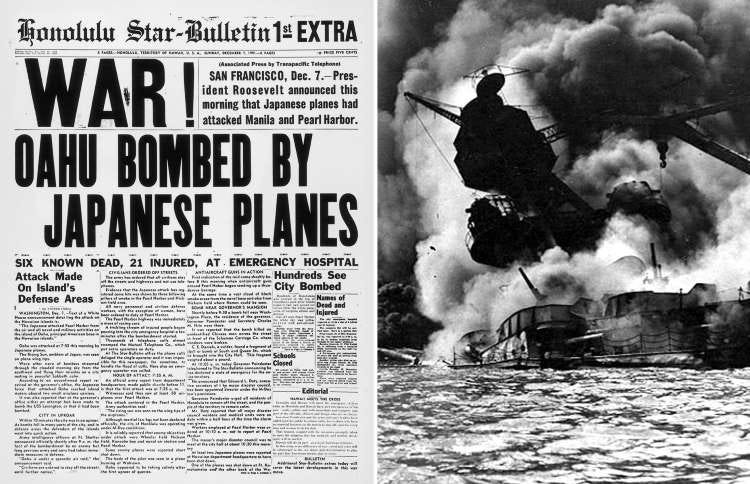
Four years earlier, Japan bombed Pearl Harbor, a U.S. Naval Base in Honolulu, Hawaii, killing 2,345 military members and 68 civilians. Speed it back up in time to Truman’s decision to bomb two major cities in Japan — Hiroshima and Nagasaki —, America had already done a lot of damage. But then the bombs were catastrophic; 300,000 to 900,000 people were killed.
How’d Stalin respond? The U.S.S.R. did not know about the Manhattan Project, thus Stalin was caught off guard by the strikes in Japan. He viewed the attacks as “anti-Soviet,” giving the U.S. “the upper hand in defining the postwar settlement.” Two weeks after the first bomb hit Hiroshima, on Aug. 20, 1945, Stalin signed a decree setting up a Special Committee on the Atomic Bomb.
And the Cold War began. This period is defined by a power struggle between the Soviet and Western blocs.
In 1949, to deter Soviet expansion into Europe, the North Atlantic Treaty Organization (NATO) was formed.
Did Anyone In The U.S. Care?
(Just after it happened:) No, no we did not care. In fact, some polls from the time show Americans wanted the military to be more aggressive. Can you imagine? This consensus can in part be blamed on U.S. propaganda campaigns: racist posters of Japanese military officials looking more like evil animal creatures than people.

Some changes to the U.S. military were coming: in 1947, the Department of War was renamed: Department of Defense, led by the Secretary of Defense. This year also saw the creation of the notoriously inept Central Intelligence Agency.
With the advent of the CIA and rising paranoia between the Soviets and Americans, it was a hostile environment for emerging democracies, as they were often used in the battle between the two blocs. And it was the dawn of never-ending proxy wars between the two countries: for instance, Vietnam was split between the communist north, funded by Stalin, and the south, funded by the Western bloc.
We are still living in the Cold War. Ukraine was one of the first Soviet states to claim independence from the U.S.S.R., alongside Georgia and Russia itself, in 1991. (Putin seeks to reclaim these losses.)
The U.S. is in the mud again, vowing support for Ukraine in its battle to keep land and maintain independence. Russia has threatened to use nuclear warfare against the U.S. and other NATO allies who are supporting its enemy. But they have made similar claims in the past, and nothing has come of it. Besides, Putin knows the U.S. has serious nuclear toys to play with, too. And as Trump comes to office, who knows how they will be used.
I guess we’ll see. Regardless, the flood of disinformation on our screens harks back to the apex paranoia of the early Cold War era in America — as propaganda filled eyes and ears — with no one ever knowing what was real. Just like today.
When will history stop repeating itself? When will countries stop killing so many lives to send a message? When will we stop destroying young countries to keep our place at the top? When will someone call us out? Can anyone do that? Is this real life? Again, I’ll ask: Does anyone care?
 ashley elizabeth miller
Please leave your thoughts!