
“Would we have Wayne Gretzky today if Walter Gretzky hadn’t built the backyard rink for his son?” asked Martin Ross, a hockey coach and father who built a $300,000 ice rink outside his Toronto home.
Ross, in conversation with the Financial Times, lamented that his labor of love has drawn contempt from neighbors annoyed at the noise of pucks hitting fiberglass at all hours of the night. Authorities ordered him to remove the rink by the end of the year.
“I grew up on the ice,” Ross said. “We skated before and after school. I wanted the same for my kids. To see their happiness on the ice, I didn’t think of the cost. I cried tears of joy.”
Outdoor rinks used to be everywhere in Canada. Now they’re hard to find. Hockey itself is fading too. One reason? Money, money, money. These days, it can cost upwards of $10,000 just to get your kid decked out in gear and on a good team — about the same as a luxury vacation at the Four Seasons on Larry Ellison’s Hawaiian island of Lanai.
I know well how expensive the sport is. As a kid, my mom made me choose: ice hockey or horseback riding — not both. It was an easy choice. Like Ross, my dad played hockey and wanted me to do the same. What little girl wants to disappoint her father, especially one who most likely wanted a boy?
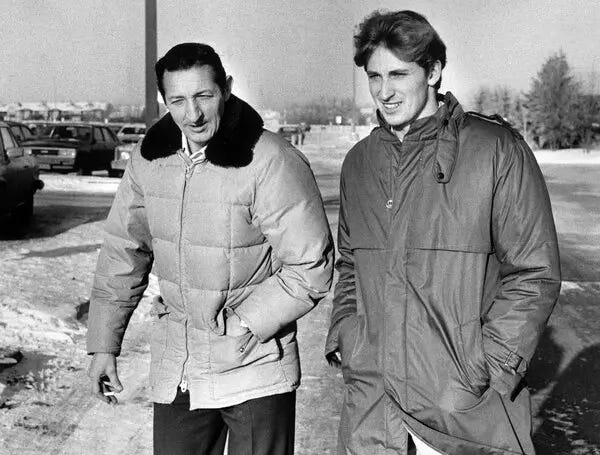
“Skate to where the puck is going to be, not where it has been.” — Walter Gretzky
Show Me The Data:
But just because the sport is expensive and the country may have fewer outdoor rinks, can we claim hockey is losing its indelible connotation with Canada? No, but data can try to help us get there.
In the 1970s and ’80s, America’s neighbor to the north dominated the National Hockey League: making up about 90% of draft picks. This year, that number is down to 33%.
(Another reason in their fall from prominence is a rise in stars from across The Atlantic. Think: Sweden, Russia, and Finland.)
Breaking Down The Cost To Play
Ross said some Canadian kids are turning to sports requiring less gear. For in hockey, a lot goes on to protect one’s body and items start to add up.
New players need: skates, shin pads, pants, shoulder pads, elbow pads, gloves, a helmet, a stick, and an endless supply of tape. When you add in the price of ice time and club fees, it’s easy to see how another sport starts to sound more appealing.
“Families are struggling to buy a house,” Ross said. “So they can’t spend up to $10,000 a year on hockey. Basketball and soccer are just so much cheaper and easier.”
Climate Change Threatens Outdoor Rinks
Up north, the Bank of Canada did a survey of spending habits on the sport earlier this year. It found parents spend about $4,500 annually on hockey, per child. That’s half a $100,000 by the time their kid turns 16. Better start saving!
Beyond money, another reason Canucks are hanging up their skates and turning their noses up at the age-old norm of outdoor rinks is climate change. Warmer weather means less time on the rink and, potentially, $300,000 down the drain.
My father was fortunate enough to grow up playing on a nature-made outdoor venue: the pond on my grandfather’s farm. As a kid, Dad would lace up his skates and shoot pucks for hours out there. I’d follow suit, but with far fewer opportunities due to warmer winters leaving the “rink” a slushy mess—and playground for cackling geese to trot around in.
More Girls On The Ice
On the bright side, more young women are playing the sport than ever before, according to the new first-ever female head of Hockey Canada, Katherine Henderson—appointed to the job last year.
I know firsthand how team sports, especially ones such as ice hockey with its rough-and-tumble reputation, can improve a young woman’s worth in this world. I hope the trend of girls lacing up their skates continues.


 ashley elizabeth miller
Please leave your thoughts!