Sex Work is Survival in Corona, Queens
Ashley Miller, Feb. 2024 (Columbia Journalism School)
- Jane Doe Ponytail: The Sister Behind The Statistic
Song Yang, 38, stood on the cement stoop of her four-story apartment building on 40th Road in Flushing, Queens. It was Saturday, November 25, 2017, two days after Thanksgiving. She wore a winter coat with a red-and-black scarf and styled her hair into a ponytail. A neon-lit Christmas tree stood outside a Cantonese restaurant on the ground floor. Yang, known as SiSi on the street, smiled and called to potential patrons: “Massage?”
Earlier in the evening, around 6:30 p.m., Yang called her brother Song Hai, 36, in Shenyang, China – a struggling city in the northeastern region. She was scheduled for a visit on December 15 to meet her new nephew. Hai was sleeping when she called, missing the chance to speak with his sister one last time, he later told me.
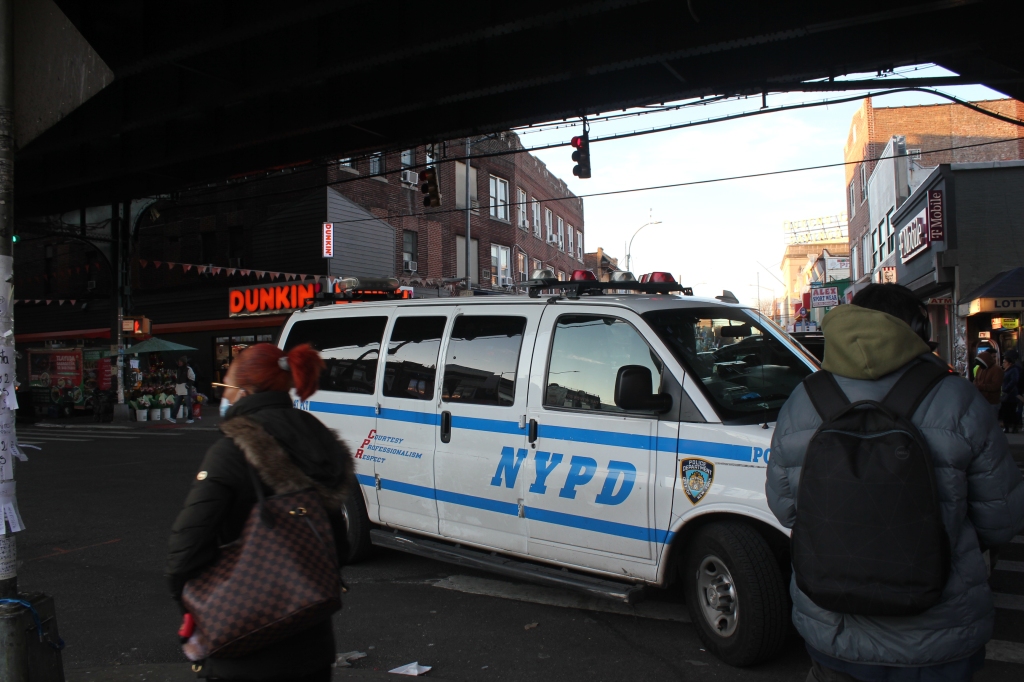
Three covert VICE Enforcement squad cars circled her block with a 10-officer team gearing up for seven undercover raids that night. Yang’s location was first due to her vicinity to the 109th Precinct. The responding unit knew her block well. From 2008 to 2017, the NYPD reported 142 complaint calls to 911 regarding “suspected prostitution” and 43 arrests.
An agent sporting streetwear approached Yang. She said her full-service fee was $80 and led him upstairs. But she soon figured he was an undercover cop when he asked to use the restroom with an undisclosed code word often used by VICE teams, according to the arrest report. The agent noted how her apartment was outfitted with surveillance equipment monitoring the stairwell and outside stoop. Footage shows Yang pushed him out of her apartment door and into the hallway. She was especially fearful of law enforcement after a traumatizing encounter the previous October.
“A police officer put a gun to my head today and forced me to perform oral sex,” she wrote to her lawyer Chen Mingli in 2016. Mingli, who was helping Yang find housing, advised her to file a complaint with the 109th Precinct of Northeastern Queens, which she did on October 13. But the investigation was short-lived and inconclusive. Earlier that year, 23 cops from the precinct were placed on parole for unrelated bribery and racketeering charges.
As four armed agents ran up the stairwell, visible on Yang’s video monitor, “she fell or intentionally leapt from a fourth-floor balcony,” according to the VICE report. Her small figure fell onto the pavement. A witness said he heard a thud and saw Yang’s disfigured, bloody face as she lay unconscious, curled in the fetal position. One responding agent noted Yang’s hair, naming her file: Jane Doe Ponytail. At 7:37 p.m., paramedics transferred her to New York Presbyterian Hospital in Queens where doctors immediately gave her a blood transfusion. Officers placed Yang, still unconscious, under arrest for her simply stating the $80 fee. She died the next morning. The autopsy cited blunt force trauma to the head and neck as the cause of death.
“My sister, indeed, was a kind girl. She was not like what people might think she was,” her brother, Hai, later told The Appeal. “She often called my parents to talk to them even when she was busy because she knew this would make them happy.”
Yang was arrested for “procuring prostitution” two months earlier, on September 27 – her third sex-work-related arrest in three years. She was scheduled for a hearing at the Human Trafficking Intervention Court in Kew Gardens, Queens, on December 1. This now-defunct system started in 2013 to curb penalties and “help defendants exit systems of prostitution” by connecting them with court-mandated counseling sessions, said Queens District Attorney Melinda Katz. But legal defenders contend the process was emotionally harmful and humiliating for clients.
The NYPD arrested more than a 1,000 sex workers the year of Yang’s death, according to city data. In 2023, there were less than 100 arrests. This drastic drop is due to a culmination of policy reforms. However, harassment and legal obstacles continue to hound sex workers.
“Yang would be alive today if law enforcement hadn’t put her in such a desperate and dangerous situation,” said Senator Julia Salazar, a progressive Democrat who serves northern Brooklyn.
Salazar campaigned on the promise to fight for sex workers’ rights. In 2019, the year she was sworn into office, Salazar introduced a bill to decriminalize sex work: The act of selling and buying sex for an agreed-upon fee between consenting adults. The “Stop the Violence in the Sex Trades Act” would decriminalize sex work and empower women like Yang to reach help when facing danger, without fear of further abuse from the NYPD.
Anti-trafficking groups, who have historically shown less empathy for sex workers like Yang, rallied against Salazar’s progressive push and threw their voices behind a quixotic pro-policing bill intending to end the trade altogether.
Senator Liz Krueger, a Manhattan Democrat, introduced the “Sex Trade Survivors Justice and Equality Act.” The bill is an extension of the Nordic Model, a policy framework seeking “to cut off the supply for the sex trade by heavily policing the customers.” Krueger and anti-trafficking groups view all sex workers as victims who require saving from the street.
The bills have stalled in the State Assembly since their introduction in 2019. But Salazar said this year is “more pressing than ever” due to the concerning police practices carried out under New York City Mayor Eric Adams.
Adams, a Democrat and former NYPD officer of 22 years, won over the post-pandemic city with his promises to tackle public safety concerns. Corona, Queens, an area known for its vibrant immigrant community, has become a particular target for Adams. As complaints of sex work, fueled by conservative media, streamed out of Queens last summer, Adams made it his mission to crack down on the neighborhood.
He is leading raid efforts along Roosevelt Avenue where women stand outside storefronts, often aside neon-lit massage parlors, in pairs of two. Adams cemented his pro-policing approach to sex work at a heated town hall in December in Corona, Queens.
“There’s a philosophical disagreement in this city on what I believe and what others believe,” Adams said. “We have a large number of people in office that want to legalize sex work and prostitution; I don’t subscribe to that.”
- Mason-Dixon: A New York City History of Sex Work
The brazen visibility of sex workers along the shaded sidewalks under the 7-train in Corona, Queens, has pitted community members against one another for 60-plus years. In 1964, Martin Arnold, a burgeoning star at The New York Times, covered the 99th Street Block Association, a Corona-based neighborhood watch group that harassed women sex workers on the street, and the outer-borough cars that circled Roosevelt Avenue searching for dates. “Corona Citizens Form Squads To Combat Influx of Prostitutes,” the headline read.
Arnold’s antiquated coverage paints sex workers as an external plaque that seeped into Corona’s innocent streets. Black women workers stood along the Avenue, and “white men from Manhattan lined the block sitting in their vehicles,” he wrote. Men from the block association patrolled the neighborhood’s streets in pairs of three, seven days a week, from 10 p.m. to 5 a.m. Their nightly watch kept “the prostitutes hopping,” said Harold Small, a firefighter and founder of the 60’s crime-fighting crew.
At the time, Corona was almost entirely Black. Italian-Americans who initially inhabited the area stayed toward the southern neck of the neighborhood. Relics from Corona’s Little Italy past are still memorialized in landmarks like The Lemon Ice King. Jackson Heights, right next door, was an Orthodox Jewish neighborhood at the time. Between them, Junction Boulevard remains an invisible dividing line, a two-mile stretch of pavement, colloquially called the Mason-Dixon due to the district’s racial divide.
“No one really knows why the prostitutes and the white clients have concentrated on Corona,” conceded Arnold in 1964. During the summer of 2023, The New York Post characterized Corona as an “NYC neighborhood overrun by brothels in broad daylight.”
Senator Salazar said this rhetoric incites anger and exacerbates existing tensions within a community. “It stokes this moral panic and contributes to the stigma of sex workers who already face all these obstacles, especially transgender women, yes, and immigrants,” said Salazar.
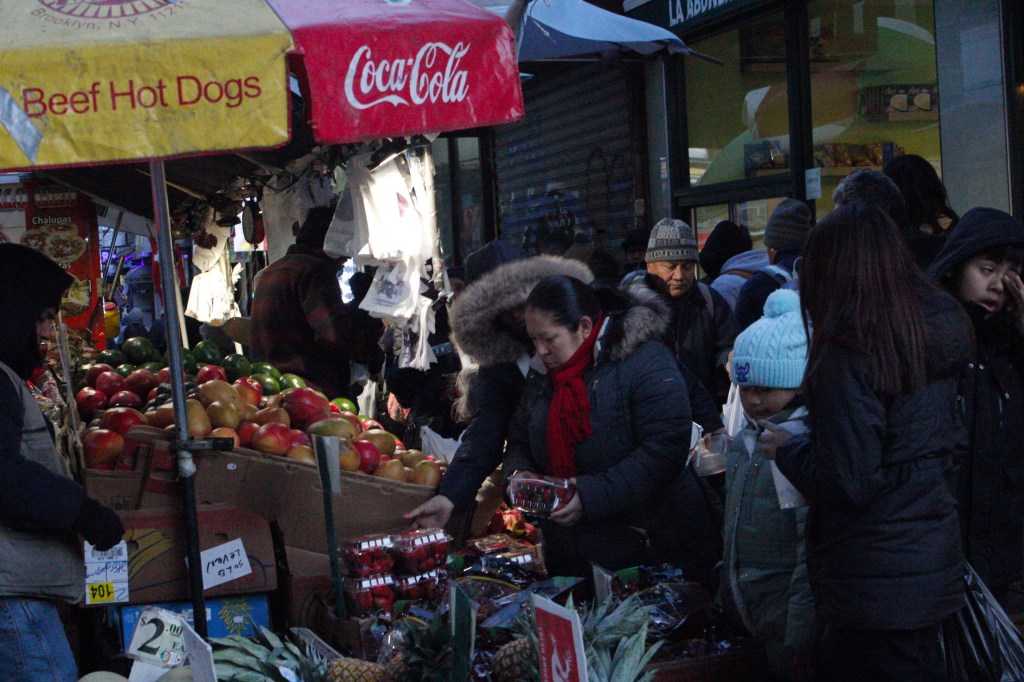
Corona has more foreign-born residents than any neighborhood in New York, according to the U.S. Census Bureau. Roosevelt Avenue is teeming with tightly packed businesses: Colombian bakeries, bodegas with corner stands full of South American newspapers, immigration law offices, Nepali jewelers with caged-off display cases, busy, brightly lit barber shops, massage parlors, and inconspicuous bars doubling as gentleman’s clubs, according to TS Candii, a sex worker in Queens.
A cultural shift occurred in the latter half of the 20th century as waves of Dominican immigrants arrived in the neighborhood. More Latin American communities settled into the mix, and a self-sustaining economy of entrepreneurs erupted. Today, there are more than 109,000 residents in the neighborhood. Sixty-three percent are Hispanic, according to census data. Dominican, Ecuadorian, Columbian, and Mexican immigrants make up the majority. Asian residents ring in second, making up 16 percent of the population.
But with the recent rise of asylum seekers in New York City, Venezuelans are joining the mix. In December, The New York Times heralded the area “Little Caracas” as a nod to Venezuela’s capital city, prompting headlines like: “Migrants are behind boom in NYC’s red-light district, Eric Adams says,” from the New York Post in November.
“A lot of them fled South America to New York, this fake progressive city, and are at risk of deportation [for engaging in sex work], and, you know, they are just trying to survive, and New York is costing them their life,” said TS Candii, 27, who turned to sex work after her parents kicked her out at 13 years old due to her identity.
Despite the neighborhood’s shifting demographic, sex work has remained a perennial profession. In 1976, a massage parlor, “Personal Touch,” located between 94th and 95th on Roosevelt Avenue in Corona, was shuttered for selling supplementary sexual services. The New York Times reported that it was the first instance of a business in the city closed for this sort of malfeasance. The same year, New York State passed legislation to criminalize loitering for the purpose of prostitution – also known as the infamous “Walking While Trans Ban.”
Today, Queens has a significantly higher number of massage licenses than the other boroughs. As of February 2024, there are 1,108 registered massage therapists in Queens, with the second highest rate in the Bronx at 297, according to the State’s Department of Education. In Corona, there is a mix of massage parlors along the Avenue: those selling sexual services, others operating straightly by the book, and some offering both massage and sex work. The NYPD and VICE send undercovers to evaluate the practices of the businesses – operations that go unsupervised. Google reviews offer an explicit lens into the services provided at one parlor.
“Ladies are beautiful and are very patient. Prices are excellent!! Will return without any doubt,” wrote Jerry Pagan, one of the many white-appearing, middle-aged male reviewers of Massage & Spa in Corona. Another less enthused patron, Chris G., wrote, “Meh spot. Women in their 40s and 50s.”
Councilmember Francisco Moya, a Democrat who represents the 21st District that encompasses Corona, is a vocal opponent of sex work and massage parlors along the Avenue. Unlike some of his district colleagues, Moya wants an increase in NYPD presence and proposes that city regulators inspect parlors routinely, which they do not currently do.

Moya, a second-generation Ecuadorian-American, first turned to civil service as a 15-year-old founding member of the Corona Gardens Neighborhood Association. Despite his family’s roots, Moya is one of the leading voices against unlicensed immigrant entrepreneurs.
“What is happening in Corona Plaza and all along Roosevelt Avenue is just out of control. It’s chaos,” said Moya.
- The Dubious Power of Policy
Ceyenne Doroshow was in middle school when she began running away from her middle-class conservative home in Bushwick, Brooklyn, to Manhattan, where she could find freedom to express her trans identity. Doroshow, now 56 years old, entered the sex trade as a means to make a living while sleeping on the streets.
“Sex work is not a choice; it’s a job for the most marginalized to survive,” said Doroshow, sitting in her Ozone Park home.
Her first experience in sex work was during a stay at the notoriously violent Fort Washington men’s shelter in Washington Heights, Manhattan. “If you want to stay here, you have to earn your keep,” volunteers told Doroshow, she said. The shelter became a brothel at 11 p.m. each night, with fellow residents paying low sums for sexual services, as well as staffers and patrons procured from the street.
“Then I found out about the Port Authority, which was a hotbed of steamy shit for a teenager, and I found out how to make coins there,” she said. Doroshow recalls the nightly routine of cops patrolling the district and sex workers running away in their high heels, hiding from headlights.
She faced routine harassment from NYPD officers for her appearance. The 1976 “Walking While Trans Ban” was disastrous for women like Doroshow due to the notorious profiling tactics used by the police, said Jillian Modzeleski, a senior trial attorney for the Brooklyn Defender Services.
The statute afforded the NYPD the discretion to decide whether a woman standing on the street was a sex worker. Potential tip-offs included “repeatedly waving” at someone inside of a nearby car and “attempting to engage passers-by in conversation,” which gave cops the legal go-ahead to stop, frisk, harass, and arrest. Officers used condoms as evidence until 2014, leading some sex workers to ditch protection altogether, exacerbating the risk of sexually transmitted diseases.
The AIDS epidemic elucidated the health risks of sex work and increased societal stigma around same-sex relations. Doroshow was navigating an increasingly turbulent terrain as the burgeoning crisis spread throughout the city, killing thousands. Between 1981 and August 1997, more than 100,000 New Yorkers contracted HIV and AIDS, according to a joint report from the Office of AIDS Surveillance and the New York City Department of Health.
“How many times have I had unprotected sex because I was afraid of carrying condoms? Many times,” said Anastasia L., a trans woman from Mexico and former sex worker in Queens, during a 2012 citywide study by Human Rights Watch. The report also analyzed the work of undercover anti-crime units deployed to investigate sting operations involving sex, drugs, and guns.
VICE Enforcement officers are legally protected to sleep with sex workers while investigating suspected trafficking rings to prove the solicitation of sex. And sex workers cannot file complaints against the cops without exposing themselves to the law. The police hold all the power.
“With the money and the time the police officers have on their hands, they’re best at getting nuts on the clock,” said TS Candii. “They stop by, we give them a gift, and they arrest us. It’s not like we put a gun to their head.”
In 1985, the peak year of anti-crime crackdowns across the city, the NYPD made nearly 20,000 sex work arrests, according to FBI data. In the last decade, there has been a dramatic decrease in arrests due to progressive reforms, starting with a 2014 citywide bill that former Mayor Bill de Blasio signed to ban the use of condoms as evidence. But they remain used in cases of patronizing prostitution and trafficking, said Modzeleski.
Layleen Polanco, a 25-year-old Black-Latina trans woman, was arrested in 2017 for agreeing to perform oral sex on an undercover NYPD detective. Polanco was again sent to Rikers Island, a 400-plus-acre island on the East River beside the Bronx that houses New York City’s largest jail, for a substance-related charge in April 2019. She was unable to pay the $500 bail required to walk free. The same year, the NYPD settled a lawsuit brought by the Legal Aid Society, where an officer admitted “to looking for Adams’ apples when deciding whom to arrest for prostitution.”
A month into her stay, on May 14, Polanco was transferred into solitary confinement after an altercation with another inmate inside the Transgender Housing Dormitory. The next day, a correction officer gave a mental health check and reported Polanco was “expressing a desire to commit suicide and attempting suicide.” In the notes section, a guard wrote, “inmate randomly crying, shouting.”
On June 7, 2019, Polanco died from an epileptic seizure in her solitary cell, according to the medical examiner. De Blasio made a citywide address following her death and announced pending punishment for 17 Rikers guards who allegedly looked the other way while Polanco suffered alone. But it’s unclear if the correction officers were ever punished.
“I think that the tragedy again, like Song Yang, is that, while Layleen was one special and unique person, her experience was tragically not unique,” said Salazar, who advocated to end solitary confinement in Rikers alongside Polanco’s family.
During a period of policing reform, from 2019 to 2021, the NYPD slowed their arrests of sex workers and centered their attention on the customers. ProPublica found that 89% of the 1,800 people accused of soliciting sex were people of color, as were 93% of the customers charged.
However, experts say that white men are the key demographic. Meredith Dank, a professor at John Jay College of Criminal Justice, has led numerous state and federally-funded canvasses to estimate the size of the “underground commercial sex economy.” In New York City, her team has interviewed more than 600 sex workers across the five boroughs and estimates at least 60% of clients are white men.
“I know for a fact that white men are the key demographic,” Dank said.
“The NYPD goes for the low-hanging fruit. And the question is, why? Are they going because that’s just the easy arrest to make, and they want the numbers?” said Modzeleski.
The typical sex trafficking narrative features a Black pimp with a trio of white scantily-clad women, said TS Candii. But she says the truth, from her 20-plus years of experience, is that Black men are the least likely to buy sex on the street.
Other police reform efforts in New York City focused much more on the police. In June 2020, prompted by the brutal police killing of George Floyd in Minneapolis, de Blasio disbanded all anti-crime units, including the “plainclothes” policing teams who performed sweeping undercover stings of sex workers’ places of business. Historically, these squads were not required to wear body cameras or recording equipment.
“As defenders trying to help our clients, we were largely working in the dark,” said Modzeleski.
Another progressive reform came from an unlikely player. In February 2021, after two years of lobbying efforts propelled by Salazar, former Governor Andrew Cuomo repealed the “Walking While Trans Ban,” which barred officers from harassing sex workers on the street. “For too long, trans people have been unfairly targeted and disproportionately policed for innocent, lawful conduct based solely on their appearance,” Cuomo said during the press conference.
The most significant reform for sex worker’s rights occurred in April 2021, when Manhattan District Attorney Cyrus R. Vance announced that his office would no longer prosecute sex work-related arrests. Adding to this landmark move, he dismissed hundreds of open cases involving sex work and unlicensed massage.
“Criminally prosecuting prostitution does not make us safer, and too often, achieves the opposite result by further marginalizing vulnerable New Yorkers,” he said. DAs in the surrounding boroughs followed suit by announcing a shared intention to no longer prosecute sex workers.
However, Mayor Adams, who ran on a law-and-order campaign, disagreed with the court’s decision. He continues to police sex work and encourages officers to work around the law by delving out nuisance abatement citations, said Modzeleski.
“They have found the loophole in the law, and they are giving certain tickets which are still criminalizing sex workers, and if you get a certain amount of tickets, it can lead to a fine or even jail time,” said TS Candii. “And they do this all on taxpayers’ dollars.”
To kick off the new year, on January 25, Adams marched down Roosevelt Avenue alongside Council Member Francisco Moya, Assistant NYPD Commissioner Kaz Daughtry, and a horde of armed officers to publicly shutter six massage parlors accused of selling sexual services.
“It’s clear what is taking place there,” Adams told reporters at a press conference after the raid.
“Investigations led to undercover NYPD officers entering the storefront on various dates where individuals agreed to perform sex acts in exchange for a fee,” Daughtry added.
Ironically, officers themselves routinely make headlines for their independent participation in the trade. The morning of the mayor’s raid along Roosevelt, The New York Post reported: “NYPD recruit busted for trying to pick up prostitutes during open-air sex market crackdown.”
- Not in My Neighborhood
On a muggy, damp September Sunday, a small squad of Corona community members walked down Roosevelt Avenue with frowns on their faces, holding sharpie-drawn signs reading: “Not in my neighborhood” and “Prostitutes shouldn’t be my role model.” A young immigrant mother from the neighborhood, Guadalupe Aguirre Gómez, led the charge. Curtis Silwa and his rag-tag neighborhood watch group, the Guardian Angels, made their way there, too.
The raincoat-wearing ralliers set off from 78th Street and landed in Corona Plaza on 104th. Silwa, sporting his iconic red beret, threatened the NYPD, saying that the Guardian Angels would take matters into their own hands if the brazen sex trade did not stop. He even accused officers of accepting bribes.
“I’ll be very blunt. They are getting paid to look the other way. This is the way prostitution operates not just here but all over the world,” Sliwa said without offering evidence. A woman opposed to the protest spat on him, according to a video from the JacksonHeights Post. Silwa would not comment on the exchange.
But Sliwa is missing the point, said TS Candii. While sex work remains illegal, officers are not inclined to arrest sex workers because they are no longer prosecuted. “It’s intentionally confusing” to discourage sex work altogether, said Modzeleski. Manhattan District Attorney Vance’s 2021 policy change did not ring clear for all to hear.
More broadly, sex work and the policies around it remain nebulous until one of these bills passes at the state level. Vance’s announcement to stop prosecuting sex workers in the city but continue prosecuting the customers aligns with Senator Krueger’s proposed bill for the state. Like Vance, Krueger and the well-funded anti-trafficking groups behind her seek to tackle the trade by cutting off the demand.
“There are a lot of people that believe any form of sex work is exploitative. No matter if the person is being forced into it or engaging in it voluntarily,” said Modzeleski.
Salazar says the lobbyists behind Kreuger’s bill are out of touch with the socioeconomic reality of those in the profession.
“I’ve met with people and groups that advocate for the Nordic Model; they often have this worldview that believes it is not possible to consent to sex when money or payment is involved,” said Salazar.
The debate between Krueger and Salazar’s two bills is live in the chambers of New York’s legislature. State lawmakers are gearing up to discuss the future of sex work laws.
“Neither bill has seen any movement in the legislature” for the past three years, said Salazar. But that’s because she co-introduced the bill with Senator Dick Godfrey in 2019, and he retired in 2021. The bill was then transferred to Assembly Member Chantal Jackson. “So there’s been a little change in that regard that can make it challenging for legislation to move,” she said.
Salazar’s sex work decriminalization bill is backed by Decrim NY, a nonprofit that educates communities about the socioeconomic realities of sex work. According to a landmark report by the United Nations in 2023, global decriminalization of sex work is essential to protect workers from stipend pay, exploitation, assault, and even murder. Her bill would also “decriminalize the use of buildings” for sex work. Under the current state law, sex workers operating from the same location, often mislabeled as being “brothels,” are liable for trafficking charges, as in “promoting prostitution.” Lastly, her bill proposes to expunge criminal records, which create barriers to employment and housing, keeping sex workers pigeonholed in the profession.
Kruger introduced a policy framework based on the widely controversial Nordic Model, which conflates sex work and trafficking charges, falsely assuming all sex workers are victims of trafficking. Undocumented sex workers, whether working autonomously or forced into an exploitative situation, can face deportation if mixed up with law enforcement.
“Conflating trafficking with sex work is because of willful ignorance and needed education,” said TS Candii.
“The anti-trafficking groups are white organizations, and their husbands are our sponsors, you know, our dates,” said TS Candii. “So, of course, they’re going to put their hundreds of thousands of dollars behind the [proposed] law,” she said because if Krueger’s bill passed, it “would prevent their white man from coming to this Black cat with a coin.”
So much of the debate around sex is shaped by narratives rather than policies. In Corona, conservative neighborhood groups say Roosevelt Avenue is dangerous for schoolchildren simply because of the sight of sex workers. Mayor Adams jumped on the issue due to compounding pressure from tabloid commentary alleging the neighborhood is “plagued with prostitutes.”
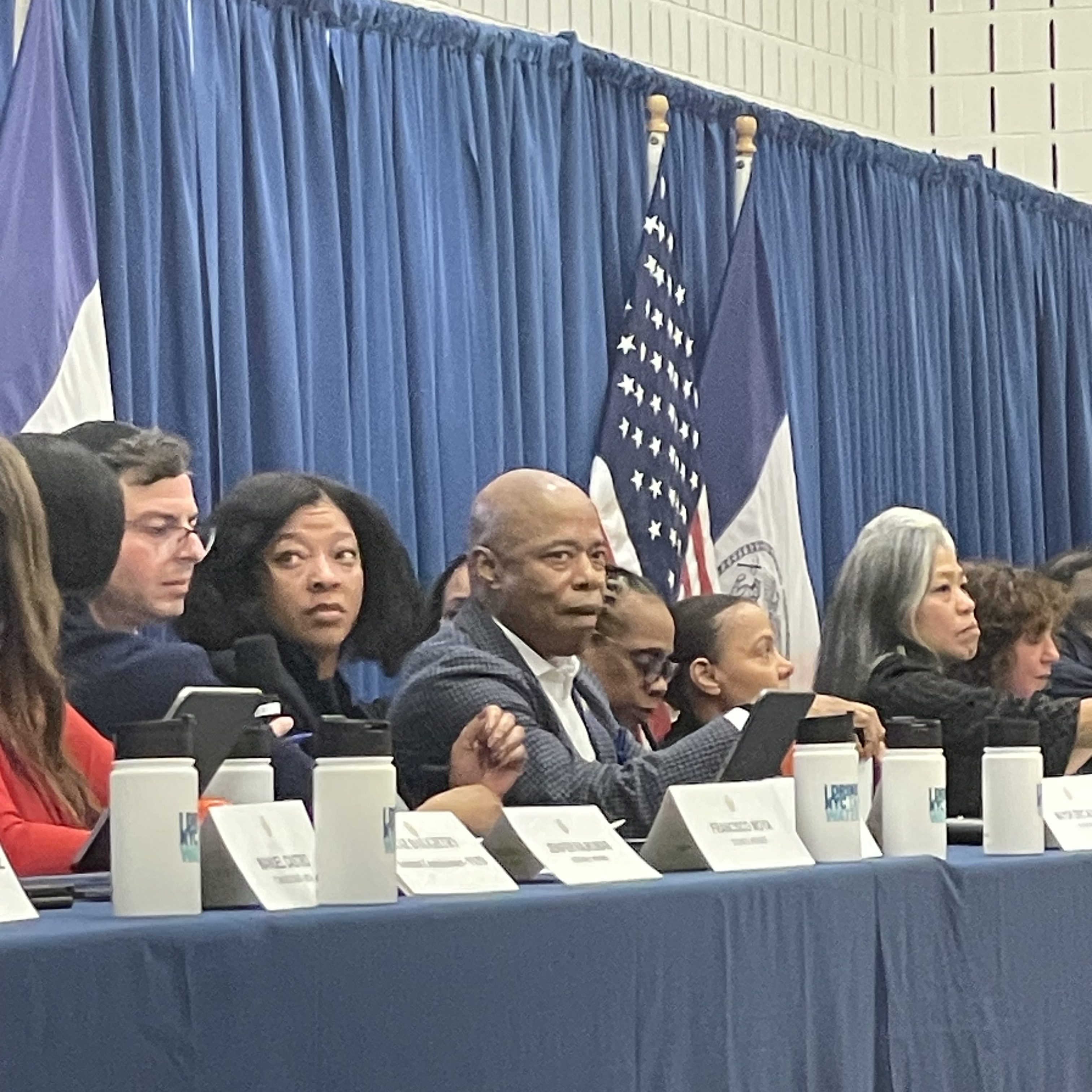
On December 18, Adams and Councilmember Moya shared the squeaky gymnasium floor of P.S. 121 Elementary School for a community conversation. An audience of Corona locals voiced complaints about sex workers loitering on the Avenue. Though sex workers are generally no longer prosecuted, arrests still occur, often prompted by these quality-of-life complaints.
“Even though we live in progressive New York City, I don’t know how many people would actually say, okay, I think voluntary sex work between consenting adults is fine,” Modzeleski said, underscoring the reality of community reactions to sex work in the neighborhood.
At the town hall, an aging school district staffer, Eleanor McNamee, took the microphone to describe some recent observations.
“Men speaking Spanish pass out cards with pictures of barely clothed women,” McNamee said. The diverse crowd nodded in consensus. “Asian women wearing short skirts stand along Roosevelt Avenue at all hours of the day, and we want to know how you’re handling this situation,” she added.
Adams assured the audience of his concern about the ubiquity of sex work in the area. Some members suggested the increase in workers is due to the newly arrived immigrants living without a path to secure other forms of employment.
But regardless of their circumstances – whether an autonomous worker, an alleged victim, or a newly arrived refugee caught in a difficult situation – Adams remains indifferent and made one point clear: “Those women selling their bodies is deplorable.”
NYPD Assistant Commissioner Kaz Daughtry said undercover officers identified 40 massage parlors selling illicit services along Roosevelt Avenue. He promised to close half the bunch in January. On January 25, Adams and Daughtry shuttered six parlors along the Avenue.
In a series of social media posts praising the NYPD’s shuttering spree, Daughtry issued a message to copycats following the January raid. “We will come, we will send out undercovers, and we will do everything within the law to shut you down,” he wrote.
Senator Salazar is unnerved by the public parading of arrests, which mislead the public and protract the narrative that sex work creates a dangerous neighborhood climate.
“I’m disturbed by the public nature,” said Salazar, referring to Daughtry’s social media feed.
“Whether it’s the Adams administration or the NYPD, they seem to be showcasing it,” she said. “That further endangers sex workers by provoking people to believe wrongly, in my opinion, that sex work is making them unsafe.”
- Crimmigation
After Song Yang fell four stories to her death during the 2017 undercover raid, immigrant and women’s rights groups spoke up and rallied around the injustice. Red Canary Song is the first coalition to specifically help Asian immigrant women working at massage parlors in Queens. The nonprofit, for example, does crowd-funding campaigns for massage parlor workers in need of financial support. In honor of Yang, their motto is “rights, not raids.”
In the years preceding Yang’s death, the number of “Asian-identifying” New Yorkers charged with sex work and unlicensed massage was on the rise. There were 12 arrests in 2012 and 336 in 2016, an exponential jump, according to data from the Legal Aid Society. Charges of any type, for sex work or unlicensed massage, leave sex workers trapped in “cycles of criminalization and systemic poverty” for years, said Jared Trujillo, policy counsel at the New York Civil Liberties Union.
Trujillo said massage remains “one of the only unlicensed professions where its workers and associates are frequently subject to arrest and police violence, and over 90% of those arrested are Asian women and non-binary people.”
Undocumented sex workers face compounding charges and even deportation if caught by law enforcement. This becomes another optics ordeal when the law tries to differentiate between sex work and trafficking, qualifying the workers as victims or defendants. In 2013, a New York City judge, Jonathan Lippman, proposed a new court system – The Human Trafficking Intervention Court – to connect sex workers and suspected trafficking victims with social services versus jail time.
New York became the first state in the nation to roll out the specialized courts “designed to intervene in the lives of trafficked human beings and to help them to break the cycle of exploitation and arrest,” Lippman said in September 2013, during the inauguration.
But sex workers and civil service defenders, such as Modzeleski, say, “Any face-time in court is humiliating” and potentially detrimental to a sex worker’s safety.
Yang sat behind the defense, or “victim podium,” twice in the Queens Human Trafficking Intervention Court and completed a series of mandated counseling sessions before her death.
When DA Vance announced the 2021 policy change to no longer prosecute sex workers, the specialized courts were closed for good. There was no tangible way to tell if the Queens HTIC was “helping women exit systems of prostitution” because trial files were erased after the “victims” finished their court-mandated sessions. And troubling reports from the past decade reveal that U.S. Immigration and Customs Enforcement agents used the courts to detain undocumented “victims.”
Sex work policy reform in New York City is, in many ways, subject to the direction in which the political winds blow. For instance, the current Queens District Attorney, Melinda Katz, supports Krueger’s pro-police stance on ending the sex trade. But Katz just narrowly beat her opponent for the DA position, Queens progressive Councilmember Tiffany Cabán, in 2019. Cabán holds a staunchly different position on the subject of sex work. She was raised in a working-class Latino family in Queens and, thus, knows the sex workers on the street. Unlike Katz, she sees sex work as work.
Despite DA Vance’s 2021 policy change, Katz continues to prosecute sex workers in the Queens Criminal Court, according to records from the Queens DA’s office. In 2023, she prosecuted 32 sex work-related incidents, according to data from the New York Division of Criminal Justice Services, through a Freedom of Information Law request. Brooklyn had 17 prostitution arrests, Manhattan had 12 arrests, the Bronx had eight, and Staten Island had five.
“I think it is safe to say or completely reasonable to say that because Melinda Katz is the district attorney and Tiffany Cabán is not the district attorney in Queens, more people are criminalized for participating in the sex industry,” said Salazar.
- Moving Forward
Cecilia Gentili was born in 1972 in Gálvez, Argentina, a small rural town in the northeastern region of South America’s second-largest country. Her father was rarely home, and her mother suffered from depression, according to her memoir. They lived in government housing, where a neighbor sexually abused Gentili throughout her childhood.
Gentili came out as transgender to her family at 12 years-old, a brave decision for a teen growing up in a devoutly Catholic country in the throes of political upheaval. She first experimented with wearing women’s clothing to a church service. But the priest ostracized her, and she was thrown out, tainting her relationship with religion.
“At the time, there was no openness,” Gentili told Interview in 2022. “Religion is such a complicated issue for most queer and trans people.”
Gentili grew into her trans identity in her early teens. She started engaging in sex work and was empowered by the financial freedom the job afforded. But faced routine harassment for her appearance throughout the 1980s and 90s. She fled South America for the United States in 2003, landing in New York City. Gentili was exploited as an undocumented trans woman with a self-professed heroin addiction. She accumulated arrests and landed in the men’s ward of Rikers multiple times, where she suffered further abuse as a trans woman.
“As a sex worker, I have ended up in Rikers Island, and it’s an experience that I would not wish on anybody, not even my worst enemy,” said Gentili during a lobbying event for Salazar’s sex work-decriminalization bill in 2019.
After Rikers, she quit drugs to never risk going back. She spent 17 months in a rehabilitation clinic and exited with a new love for life. Gentili found her vocation in advocacy work, fighting for the most marginalized: sex workers, immigrants, and LGBTQ+ people of color. She swiftly climbed the ladder as managing director of policy at GMHC, formerly known as the Gay Men’s Health Crisis, a nonprofit dedicated to the prevention of AIDS. Gentili co-founded COIN – Cecilia’s Occupational Inclusion Network – in 2021, the first healthcare center exclusively for sex workers on the East Coast.
“There are so many things to translate to your medical provider if they’re not sex worker-friendly,” Gentili told Paper Magazine following the launch. “I think having a space when it’s understood from the get-go creates that clear space where you can go and be yourself and be like, ‘My knees are so fucked up because I’m a stripper.”
She cemented her larger-than-life status in 2023, writing, producing, and directing her off-Broadway one-woman show Red Ink. The production, complete with a series of extravagant outfit changes, is a semi-autobiographical account of her life that followed her story of abuse in Argentina, at the hands of her rapist and complicit community, to her life in New York City where she ascended to an iconic status. The story combines humor with the harsh realities of growing up trans in a xenophobically-inclined world.
“I wanted them to laugh but also to wonder why we have to make trans people’s lives so hard,” she said, following the show’s run.
Gentili’s global following helped her become a powerful lobbyist. Back in 2019, Gentili worked closely with Senator Salazar, lobbying and rallying support for the repeal of the “Walking While Trans Ban.” And when former President Donald Trump tried rolling back trans protections in the Affordable Care Act, she successfully led a suit against him.
“I had the privilege of knowing Cecilia and learning from her for years, even before becoming elected. She was,” Salazar said, “just prolific and beloved.”
Over the past two decades, Gentili has served as a voice and advocate for the most marginalized in New York City. Her fans were distraught to read the news of her sudden, unexpected passing in a statement posted to Instagram on February 12. She was 52 years-old. Her longtime partner, Peter Scotto, announced Gentili’s death, which occurred overnight in their Brooklyn home. It was fitting that Ceyenne Doroshow threw Gentili, her fallen friend and fellow iconic activist, a funeral.
Doroshow arranged the highly publicized celebration of life at the famed St. Patrick’s Cathedral in Midtown Manhattan. Legends such as Andy Warhol and Babe Ruth were memorialized in the same towering church. “I have not seen a crowd that big since Easter Sunday,” said Father Edward Daughtry, who ordained the service. But throughout the morning, Daughtry repeatedly referred to Gentili as a man. The 1,400 extravagantly dressed attendees were not surprised by his ignorance, according to Doroshow.
“I’m showing my entire ass today, with a corset, bra, and garters, in the largest and most renowned cathedral in the country, because that’s what my mother would have wanted,” said Fran Tirado, a queer-activist and journalist based in New York City, referring to Gentili before the service.
The real controversy erupted after the funeral was finished. St. Patrick’s Cathedral grew enraged upon learning Gentili was not a practicing Catholic, which Doroshow led them to believe.
“If a cisgender person’s family organizes their funeral, does their family tell the church that they were cis?” Doroshow later asked the Post. “If not, why is that being asked of us?”
St. Patrick’s issued a statement saying the staff “had no idea our welcome and prayer would be degraded in such a sacrilegious and deceptive way.”
Sex workers and trans rights activists gathered outside New York City Hall to lobby for an apology from St. Patrick’s Cathedral. “She does not deserve this. Her husband does not deserve this. Her family does not deserve this,” saidDoroshow.
“Cecilia Gentili’s legacy is bigger than the Catholic church,” said Salazar, who is preparing for her next State committee meeting about her decriminalization bill. She says Gentili’s passing will rally crowds of supporters like the Assembly has never seen and could be the straw to finally set sex workers free.
“Her legacy will empower marginalized people to live boldly and unapologetically and not be ashamed of simply being who they are,” Salazar said.
 ashley elizabeth miller